


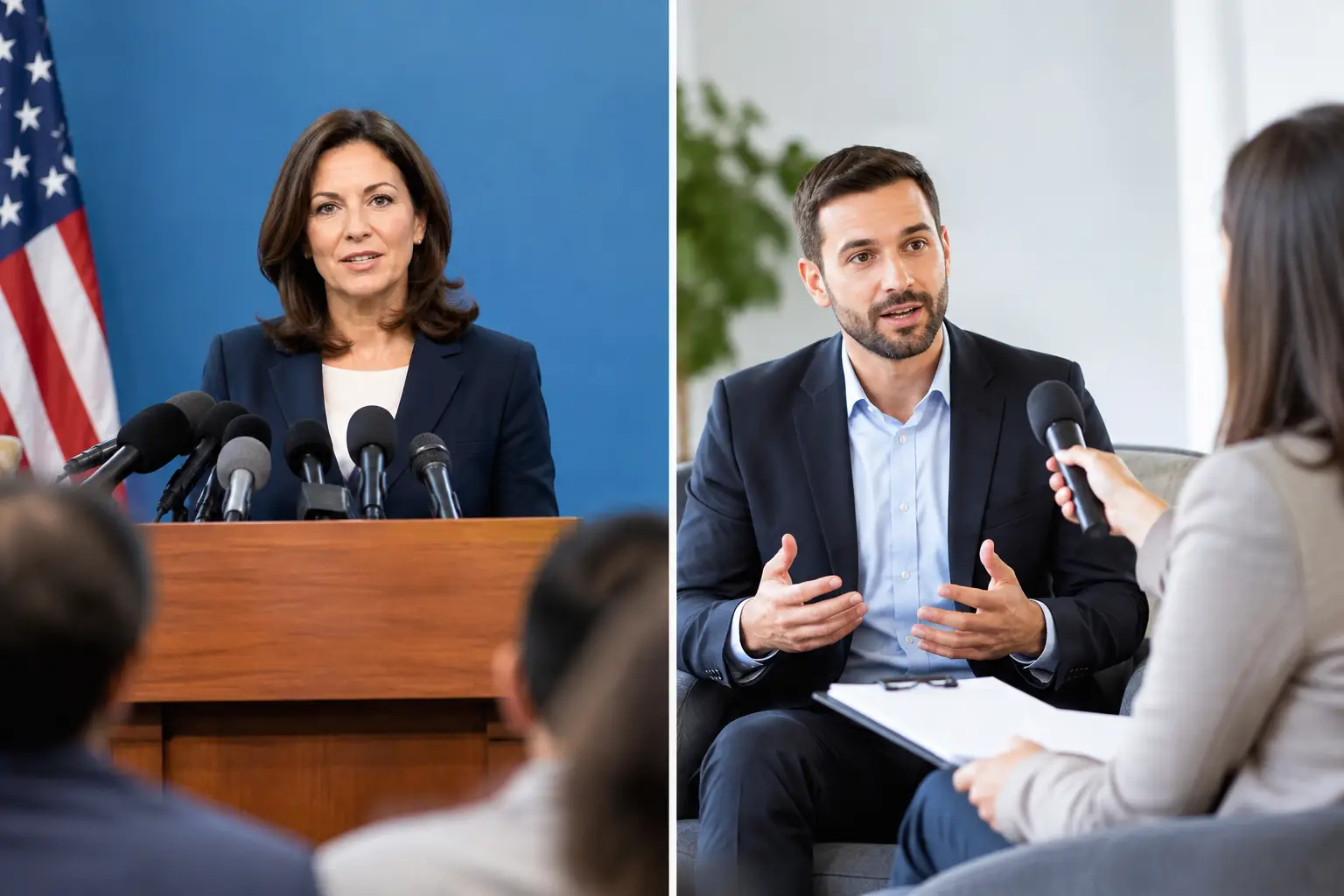
Press Conference Versus Media Interview

A press conference versus media interview is not a choice between two versions of the same task. They are different performance environments, with different risks, different opportunities and different demands on the person speaking. Treating them alike is one of the quickest ways for a senior leader to lose control of a story.
The strongest leaders prepare for the format, not merely the subject. They know whether they are creating the news, responding to it, defending a position or giving an audience confidence that the organisation is in control.
The crucial difference is control
In a media interview, the journalist usually controls the frame. They choose the angle, determine the line of questioning, edit the exchange and may challenge the premise of your answer. Even in a live interview, the presenter decides when to interrupt, move on or return to a point you would prefer to leave behind.
A press conference gives the organisation more initial control. You can set the time, venue, opening statement and broad reason for the event. That matters when announcing results, a major transaction, a leadership change or a response to a developing crisis. But the control is limited. Once questions begin, multiple journalists can test the gaps in your statement, compare answers and pursue the same weakness from different directions.
The mistake is to assume a press conference is therefore safer. It is not. A poor interview may produce one damaging clip. A poor press conference can create several, while also giving reporters material to build a wider narrative of evasion, confusion or internal disorder.
For senior leaders, the issue is not which format feels more comfortable. It is which format best serves the business objective and whether the spokesperson can perform credibly under that particular form of pressure.
When a press conference is the right choice
A press conference works when the organisation needs to speak clearly, visibly and at scale. It can signal accountability after a serious incident, establish a definitive position before speculation fills the vacuum, or allow a chief executive to explain a complex announcement directly.
It is particularly useful where there is a strong central message that should be heard consistently by several outlets. An opening statement can provide context that a short interview may not allow. It also demonstrates that the organisation is not hiding behind a written holding line when stakeholders expect to see leadership.
Yet visibility is not the same as credibility. A leader who reads a polished statement, then collapses into vague language under questioning, creates a sharp and unhelpful contrast. Journalists will remember the unscripted answer, not the prepared introduction.
The effective press conference spokesperson needs a disciplined structure: a clear opening position, a small number of proof points and firm boundaries around what cannot yet be disclosed. They must also answer the question asked before returning to the wider message. Repeating a key phrase without addressing the challenge does not look controlled. It looks evasive.
This is where presentation skills for executives become highly practical. The room is watching more than the words. Pace, pauses, eye line, posture and the ability to absorb an interruption without showing irritation all influence whether the leader appears authoritative.
A media interview is a test of judgement
One-to-one interviews are often more demanding than leaders expect. The setting may be quieter, but the scrutiny is more concentrated. A skilled journalist can use silence, repetition, a false choice or a seemingly simple question to expose uncertainty.
The danger is over-explaining. Senior professionals are used to nuance, caveats and detailed briefings. In a broadcast interview, too much context can bury the point and leave the journalist with an answer that sounds incomplete. The audience will not reward complexity if it obscures responsibility or action.
Handling interviews well means being precise without becoming mechanical. A strong answer usually starts with the direct response, gives the relevant evidence and then explains what happens next. If the question is hostile, the leader should neither accept an unfair premise nor waste time arguing with the interviewer. Correct the premise briefly, state the facts and move forward.
Consider a chief executive being asked whether a product failure proves the company has put profit before safety. A defensive denial is weak. So is a lengthy technical explanation. A credible answer acknowledges the seriousness of the failure, makes clear what is known, explains the immediate action and commits to the next update. That is not media polish. It is visible judgement under pressure.
Media training for leaders should therefore recreate the conditions in which their habits become exposed: interruption, scepticism, time pressure and difficult follow-up questions. A briefing document cannot show a leader how their answer lands when they are challenged three times in succession.
The preparation is different, even when the message is the same
The core facts may be identical, but preparation should not be. For a press conference, leaders need to prepare for breadth. Questions may range from financial impact and operational detail to staff morale, accountability and whether the board was warned. The spokesperson needs a coherent narrative that can withstand several journalists approaching the issue from different angles.
For an interview, preparation needs greater depth. Identify the likely editorial frame, the journalist's most difficult question and the answer that could be taken out of context. Then test the leader's ability to make their point in a short, broadcast-ready response without sounding rehearsed.
Both formats require message discipline, but discipline is not memorising phrases. It is deciding what the audience must understand, what evidence supports it and where the organisation must be candid about uncertainty. Leaders damage trust when they fill gaps with speculation simply because silence feels uncomfortable.
The same principle applies to body language. In a press conference, an overly rigid stance can appear remote. In a studio interview, restless hands or a wandering gaze can look defensive on camera. These details are difficult to judge from a written brief or a mirror. They need to be observed, challenged and refined.
Dark Star's BBC broadcast pedigree informs a practical approach: filmed exercises, replayed immediately, reveal the gap between what a leader intended and what an audience actually sees. The footage may show that a measured answer sounded hesitant, or that an attempt at reassurance came across as dismissive. That is useful evidence, not cosmetic feedback.
Do not let format dictate the outcome
The best spokespeople do not try to win every question. They aim to leave the audience with confidence that they understand the issue, are taking proportionate action and can be trusted to communicate again when there is more to say.
That standard applies in both settings. A press conference rewards composure across a wide field of scrutiny. A media interview rewards concise answers, sound judgement and the ability to hold a line without sounding managed. Neither can be improvised because the leader knows the business well.
Before accepting either format, ask a harder question: can the person speaking deliver the message with clarity when the question is unexpected, the camera is live and the answer carries reputational consequences? If the answer is uncertain, rehearsal under realistic pressure is not optional. It is the work that protects the performance when it counts.


Comments